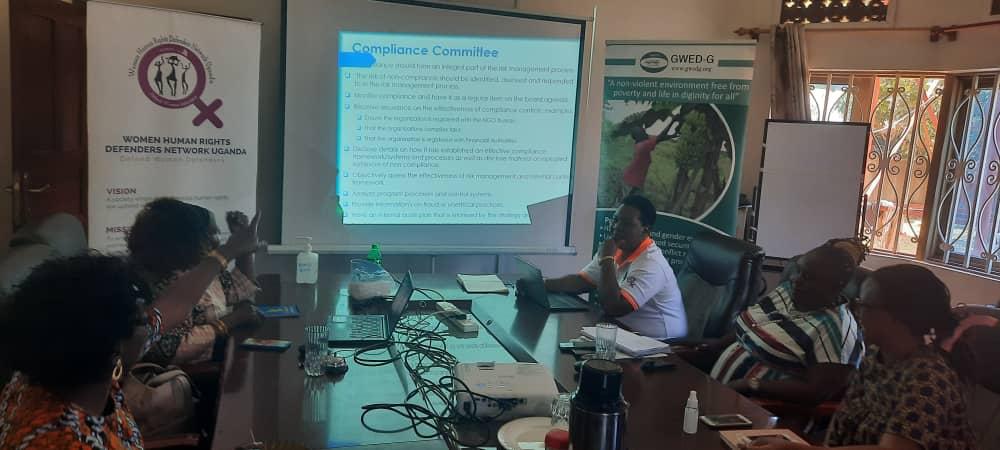
Our Executive Director, Brenda Kugonza and Finance & Administration Officer Sheila Namudde have joined @WHRDNU board members at @GWEDGUga offices on a learning visit on Technical support of cooperate governance and financial management. pic.twitter.com/zzKzrdSY1B
— Women Human Rights Defenders Network- Uganda (@WHRDNU) February 16, 2022
The engagement over the two days covered areas on
Risk analysis plan
Internal audit plan
Job descriptions
In addition, practical skills were shared in resource mobilization , cultivating positive stakeholders relationships and human resource management. We extend our gratitude to Gulu Women Economic Development and Globalization for the hospitality throughout the two day visit.
In its list of issues, the Committee asked the State Party to “advise on specific legislative measures in place to protect the rights of women human rights defenders… (para 7)”.
Women human rights defenders in Uganda are facing particular challenges on account not only of transgressing gender norms in taking up the work of promoting and protecting human rights, but also often because of the nature of their work. HRDs identifying as or working with the LGBTI community are at particular risk, as are those working to promote and protect the rights of sex workers. Furthermore, land and environment WHRDs working as parts of communities to oppose resource extraction and mining operations have been threatened and intimidated by non-State actors and a number have faced arrests.
The draft bill on the Protection of Human Rights Defenders was tabled in 2020 and sits before the parliament. The adoption of this bill is important for the recognition of the work of all HRDs and would legitimise their rights to defend rights within the national legal frameworks. We call on CEDAW to recommend that the State genuinely engages with WHRDs to ensure that the bill and its implementation plans are fully gender responsive.
Brenda Kugonza presents statement during Zoom meeting on February 7th 2022
Meanwhile, the government of Uganda must review and reform other areas of its legislative framework in order to bring them in line with international standards. In particular, we urge the CEDAW Committee to call on the State to engage with civil society for the review and reform of the following:
The Computer Misuse Act, 2011 (section 24 and 25 in particular), under which charges of cyber harassment and offensive communication can be
The NGO Act, 2016 restricts the rights to freedom of expression, association and peaceful Application of section 44 can result in restrictions for WHRDs working for groups regarded as illegal, such as sex workers and LGBTI persons.
Section 145 of the Penal Code Act penalises same-sex relations. Further, an Anti- Homosexuality Act was operative for 5 months in 2014; during this period numerous cases of violations against the LGBTI community were reported, including arrest, physical violence and harassment.
The Anti-Pornography Act is often misused against WHRDs promoting rights related to gender and bodily
Women Human Rights Defenders Network Uganda Executive Director, Brenda Kugonza present an oral statement at the CEDAW NGO meeting for Uganda Review on 7th February 2022
“The enactment of a single law on the protection of Women Human rights defenders is an important step forward but insufficient without a holistic view of the legislative environment in which WHRDs operate. pic.twitter.com/OKk3PxHTIl
— Women Human Rights Defenders Network- Uganda (@WHRDNU) February 7, 2022
We stress that that the enactment of a single law on the protection of HRDs is an important step forwards, but insufficient without a holistic review of the legislative environment in which human rights defenders operate in order to address the root causes of the violence and discrimination that WHRDs are facing in Uganda. Thank you.
Executive Women Members of Parliament were called upon by Women Human Rights Defenders (WHRDS) to advocate for Gender inclusive bills as a means to strengthen the security of WHRDS in Uganda. This was during the breakfast meeting organized by Women Human Rights Defenders Network (WHRDN-U) in partnership with UWOPA on 28th January, 2022 at Golden Tulip which aimed at raising awareness on gender-based concerns for WHRDS.
Speaking at the meeting, Ms. Mary Harriet Lamunu, Executive Director UWOPA explained that the breakfast meeting was to happen in 2021 but due the absence of their chairperson who had travelled to Arusha, it was extended to January 2022. She thanked the WHRDN-U team for engaging with them and promised to continue engaging with more MPs to handle issues that affect the women human rights defenders.
The Executive Director UWOPA giving her welcome remarks during the workshop.
In her remarks Brenda Kugonza, the Executive Director WHRDN-U mentioned that the shrinking space has impacted on the work of WHRDs. By working with the parliament, will create a safe working environment for WHRDs. She illustrated how WHRDN-U defends the women human rights defenders who defend the rights of land, the disability, LBQT and sexworkers, female journalists, and ethnic indigenous. Brenda further clarified that patriarchal is real, Female MPs are attacked when defending the laws and acts that protect women.
Sandra Kwikiriza from Her Internet told the congregation how online violence has affected many women including WHRDS. She asked members of parliament to ensure their security online by not sharing certain information related to their private life online and hide their passwords with others. “There is no good reason for me to share my email/ social media password. In reality, most of us share our passwords with our partners. I don’t have to share my password because someone can log in my account and misuse my platform”.
Sandra Kwikiriza facilitating on online violence
Members of Parliament also gave their opinions on online violence and how they have been in their leadership roles. Hon. Betty Naluyima commented that online violence is happens in the real life and she has been a victim when she was attacked online, by her opponents. “Regardless of the violence, “we will not stop” this is a crucial war and we want them to listen. We can’t give up any time no matter what happens”.
“Gender stereotypes affect women more when it comes to violence and threats online. For example, women receive more negative comments than men when it comes to sharing same information online”. Hon. Okia Joanne.
Hon. Members of Parliament expressing opinions on online violence
WHRDS shared testimonies on how they had been attacked online because of their human rights work. “During lockdown, teenage pregnancy cases were very high. It so happened that a young girl was defiled by a 40-year-old man and I shared this on Facebook, instead people abused me and this put me down. I regretted why I had put the story there”. Mwanje Caroline, WHRD from Kagadi.
“As a female journalism during lockdown, I posted stories of defilement and called for dealing with men who can’t control their sexual desires. Because I posted what people didn’t like, I was insulted, and humiliated for not having a man. I thought of leaving Facebook”. Sarah Chekwech, WHRD from Kapchorwa.
“When women with disability post pictures of our work, we are harassed. I campaigned on Facebook about a family that planned to steal land of a widow. I almost relocated because of attacks on my body. People said my body is ugly, unattractive, and that I should hide instead of exposing it on Facebook and in public. I am happy that I supported the woman amidst intimidation”. Peluce Kabagenyi, WHRD from Kasese.
“As a female journalist, in 2021 during lockdown, when I posted stories of defilement and called for dealing with men who can’t control their sexual desires and because I posted what people didn’t want, they harassed me, they went below my belt attacking me for not having a man, I sated thinking of leaving Facebook”. Goretti kajumba, WHRD from Kabarole.
“My colleague was attacked online for her activism work in the mining in Moroto. They used photo shop to put her head on a naked woman and it went viral. We later found out that our colleague’s bottom parts had a scar and the photo posted had no scar”. Flavia Aballo, WHRD from Kampala.
WHRDS testifying how they have encountered online violence in their human rights work.
“I was hosted on a talk show to discuss GBV in Busoga, men attacked me on social media saying that am not supposed to comment on marriage issues because I am not married. They used messages such as ‘The spoilt girl should not mislead you’ to humiliate me”. Kyemba Rosemary, WHRD from Jinja.
In her speech, Hon. Sarah Opendi the Chairperson UWOPA thanked WHRDN-U for being a back a backbone of women huma rights defenders and encouraged the network to continue carrying on human rights work. She testified how she has been a victim of online violence, which is why she is not on Facebook. Someone created an account in her name, and promised people jobs and stole money from them.
Hon Sarah, further shared she was attached on social media for advocating for the rights to safe abortion. We must continue until we reach where women’s rights are respected and also where women and girls are not looked at or perceived as sex objects. She also mentioned that they will be bringing back the marriage bill to parliament and more amendments will be made like from woman MP. We are also bringing forth the Surrogacy bill. Infertility is not a matter for women alone but also a man’s issue.
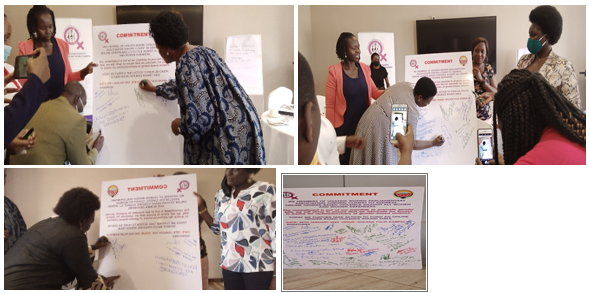
The Executive a pledged to support WHRDS through working with WHRDN-U to promote safety and security on WHRDS in Uganda and advocating for gender responsive bills in members through signing a commitment form at the breakfast meeting.
Sarah Opendi, chairperson UWOPA signing the commitment
Hon. Members of Parliament signing on a commitment board to advocate for gender responsive bills during the breakfast meeting.
The COVID-19 pandemic disrupted the human rights defense work of WHRDs in Uganda, who work to protect human rights for all, create peace, gender equality, and ensure that justice is served for SGBV survivors.
Global Fund for Women (GFW) stood in solidarity and ensured that WHRDs continued their activism. GFW provided WHRDs – frontline defenders with essential supplies through the Crisis Fund. These supplies included; safe transport, food, face masks, hand sanitizers, communication (became a basic need in this crisis) and types of support were related to phone-recharging, purchase of credit, cell phone. Thereby facilitating them to mobilize, organize, reach out to various communities and support online activism as some WHRDs wanted to move online (WhatsApp, Facebook & Twitter) to do their activities. Read stories below of how the fund helped WHRDs to do their work in Uganda:
Ms. Juliana Among, Ms. Napiyo Madalena and Ms. Nabong Margret of the Ik ethnic indigenous minority group, used the relief funds for transport to go and register their group to legally operate in Kamion subcounty, Kaabong District. They were able to continue with promoting the rights of IK indigenous communities.
A copy of the recommendation letter to attain a certificate of registration being signed.
Ms. Edreda Dogolo, Ms. Grace Mbatina, and Ms. Rhoda Kabalisa the Batwa indigenous minority WHRDS from Bundibugyo, used the funds to organize Batwa women for a sensitization meeting on their rights to access the semiliki forest as their ancestral land. They also distributed food to Batwa women.
Ms. Roda Kabalisa a WHRD carrying out an awareness sensitization meeting in the Batwa Community
Robinah Tibakanya a WHRD from Hoima district used the relief funds to buy airtime for communication and stationery which she used to carry out the sensitization meeting to women in Namasagali village on land rights.
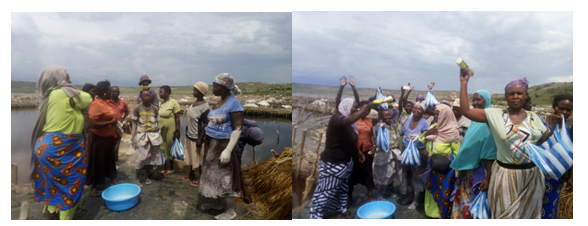
Ms. Mawa Jacky and Ms. Nasaka Halima, the WHRDS from Katwe salt mining the covid relief to distribute food to female salt miners in Kasese district.
Moreen Kyobutungi and Faridah Kugonza, WHRDS from Kabarole district used the relief funds to purchase food and soap which they distributed to the female sex workers for sustainability during the pandemic.Ms. Amono Jackline and Ms. Angeno Rose, from Mighty fire FM used the Covid relief to buy face masks and sanitizers which they supplied to fellow work mates. They appreciated WHRDN-U for the support that enabled them to continue carrying out their journalism work.
Ms. Amek Joan a WHRD from Central region, used the Covid relief to reach out to Rella House of Hope. She purchased pads and soap which were distributed to LBQT residing in the shelter.
Christine P’ochan a WHRD from Acholi used the covid relief support to pay a solidarity visit to Akol Winifred one of the WHRDS who had been attacked ,They too bought food for her.
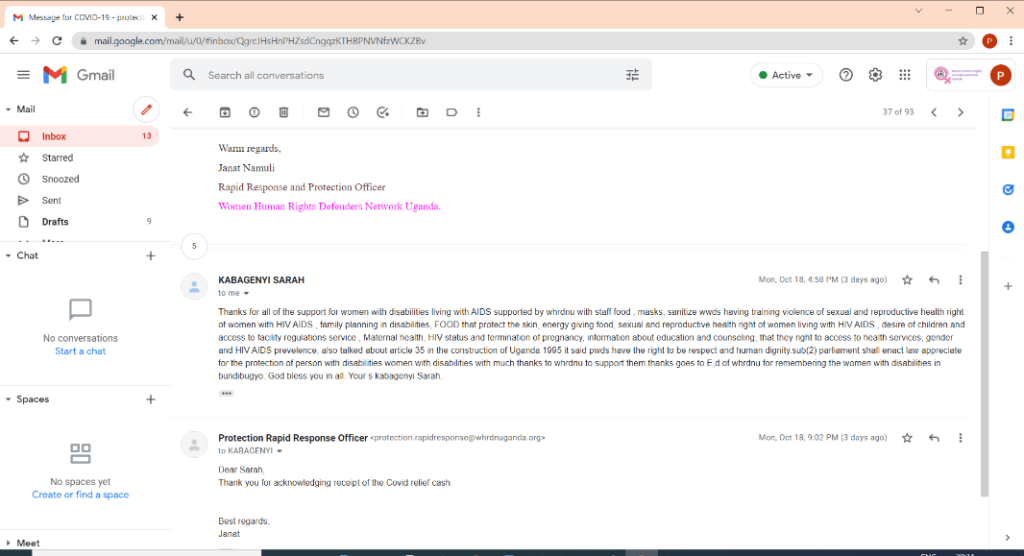
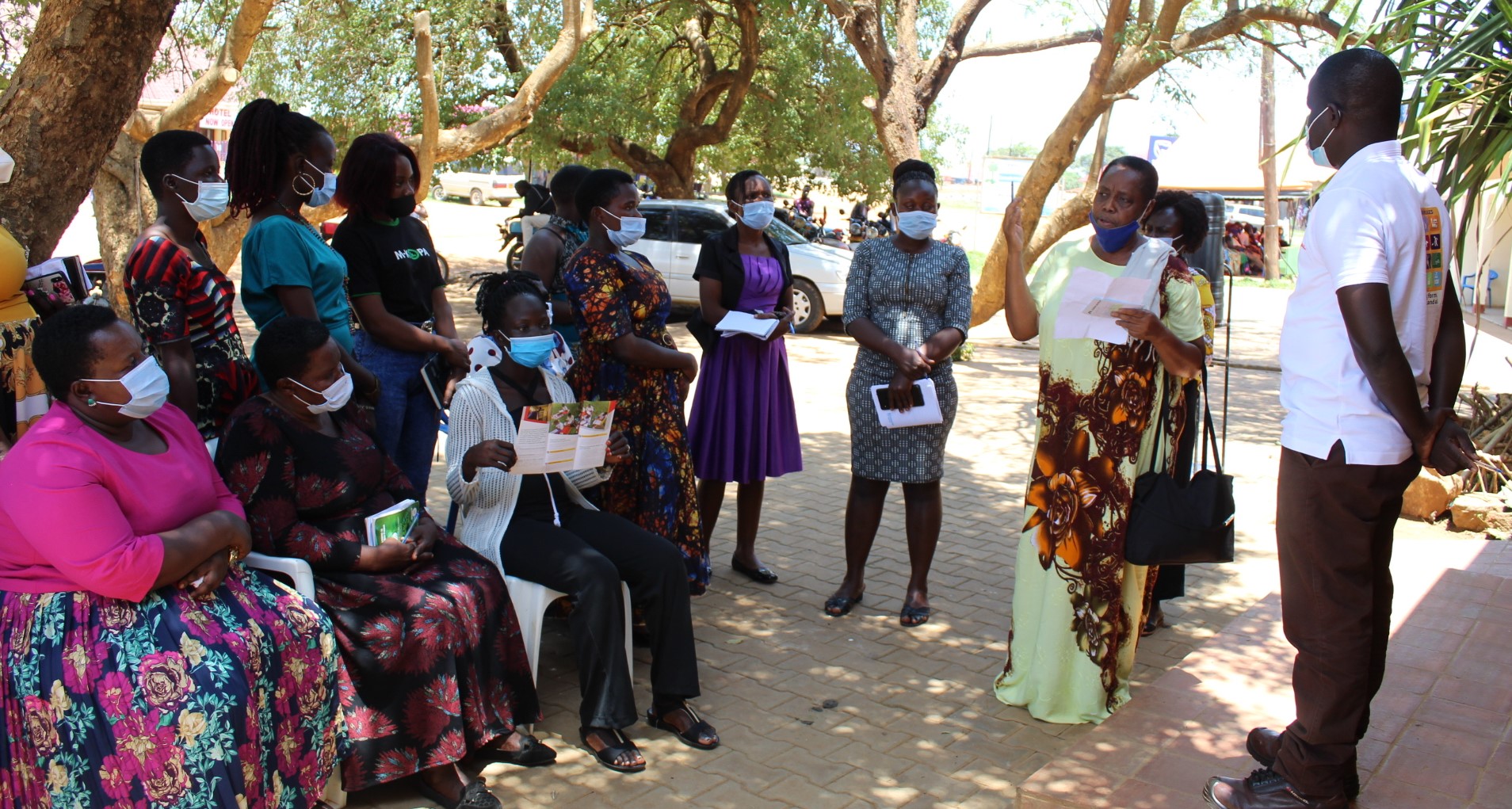
Ms. Sarah Kabagenyi, WHRD defending the rights of people with disabilities in Bundibugyo district used the Covid relief to mobilize women with disability and living with HIV to understand how and where to access family planning and Reproductive health services .Ms. Paulin Chepar an anti-Female Genital Mutilation activist under Sanayi Anti FGM movement in Amudat district of Karamoja region bought a smart phone using the covid relief money to enable her to continue with the Anti FGM campaign documenting stories and reaching out to girls escaping FGM.
Ms. Naduke Betty, a GBV activist in Kabong district during a meeting with women who had reported cases of Domestic Violence (DV) , used relief fund to give out soap to survivors of DVMs. Nabiira Ndagire( holding a copy of the Domestic Violence Act) of Tusitukirewamu women empowerment group in Bwaise. Used relief fund to give food, while talking to women that the DVA encourages them to report DV to police, health workers and courts of law.
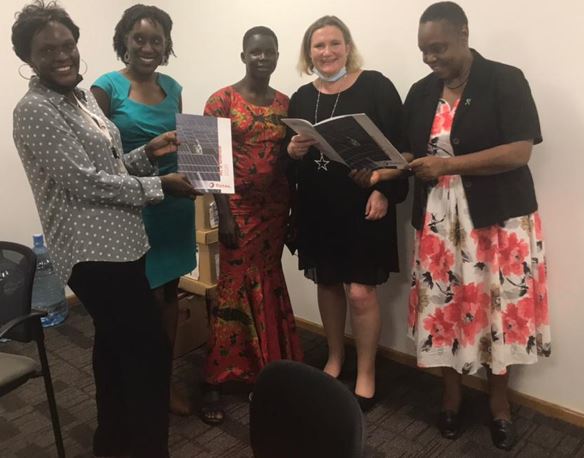
Caption:From Left to right: Sarah Kisoro (the representative of the oil and extractive action working group of WHRDN-U), Begg-Saffar (NGO and Human Rights Manager, Total Energies), Gladys Oyenyboth (Bulisa Community Grass root WHRD), Petronilla Lamunu (NGO officer, Total Energies) and Brenda Kugonza (Executive director WHRDN-U).
On 29/09/2021, Women Human Rights Defenders Network Uganda (WHRDNU) held an advocacy meeting with Total Energies’ NGO and Human Rights Department. The meeting took place at Total Energies Offices on Yusuf Lule Road, Kampala. The meeting discussed matters of protection of women human rights defenders who defend land rights of communities evicted due to oil extraction projects in Bulisa district.
We are grateful to Total Energies for using the UN principles on business and human rights and their commitment to work with Bulisa WHRDs to ensure that women’s rights are protected.
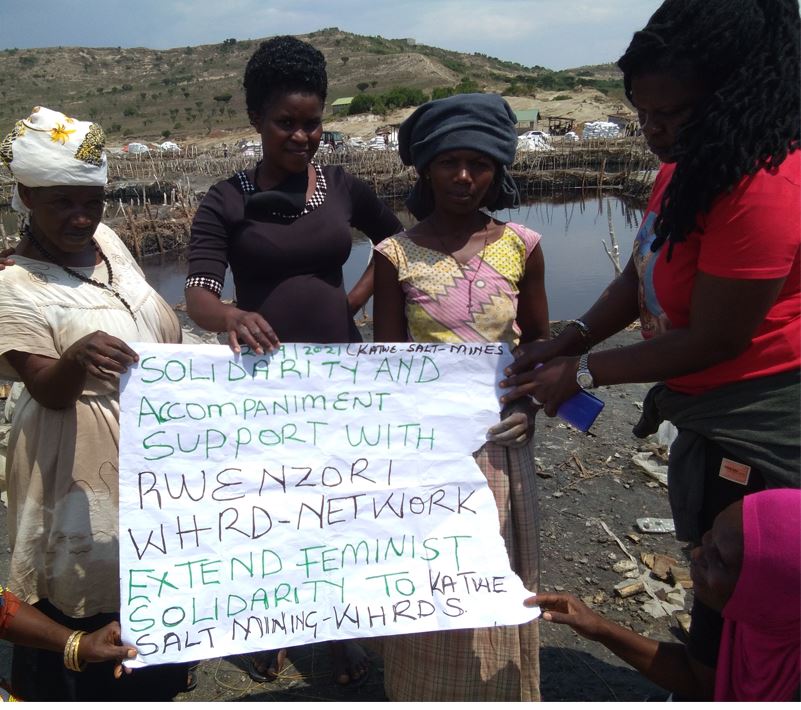
Caption: Representatives of the Rwenzori women defenders network pose for a photo supporting the work of women defenders at the grass root community of Lake Katwe Salt mines.
Rwenzori Women Human Rights Defenders Network encouraging other women to see themselves as women defenders. On 24th/09/2021, three women human rights defenders from Bundibugyo, Kabarole, Kasese districts came together through a solidarity visit to support the work of four women human rights defenders confronting historical inequalities and discrimination against women in the salt- mines of lake Katwe community.
During the solidarity visit, women human rights defenders discussed how to strengthen the liaisons, networks and how to foster local linkages to ensure the protection of women human rights defenders. Women defenders also shared personal and collective testimonies about how they are preventing and confronting violence and discrimination against women in the salt -extractive activities.
Thanks to the women defenders located in lake Katwe- salt – mining community, they are not willing to give up on promoting the economic rights & ensuring that women are not stripped of their source of livelihood which is salt mining in lake Katwe.
Caption: Ms. Sarah Kisoro thanking TotalEnergies for recognizing the contribution of WHRDs in advocating for resettlement packages for women in Albertine region.
Based on the principle of collective power is louder and networks can save lives, a key strategy of the WHRDN-U is the creation and support of regional (rural) women human rights defenders networks and coordination of joint actions. WHRDN-U supported regional networks in Albertine, Acholi, Rwenzori and West Nile regions as a joint platform for advocating and confronting violence etc. Below are key actions of WHRDs-Regional Networks.
KEY ACTIONS OF WHRDS- REGIONAL- NETWORKS
Women Human Rights Defenders from Albertine region have not abandoned their human rights work of engaging extractive Industries.
The Women Human Rights Defenders Network Uganda (WHRDN-U), has created the WHRD -Albertine- regional -network, that has helped WHRDs to take collective actions. For instance; On 23rd and 30th August 2021, the WHRD- Albertine – regional network in collaboration with 17 Women defenders from Kagadi, Masindi, Hoima, Bulisa, and Kiryadongo districts of Albertine Region, engaged with Total energies’ NGO desk at their offices in Bulisa district. In the meeting, Women Defenders highlighted their contributions in the Albertine region noting as women they have promoted peace and justice, economic and political rights, challenged discrimination and promoted equality for everyone.
The women defenders informed the team from Total that they also work to amplify the concerns of women and community members who have suffered land evictions due to oil extractions. In the meetings, discussions also focused on how women tend to be excluded from the economic benefits and negotiations about the fate of their territories.
Several actions were also proposed to strengthen working relationship between WHRDs and Total energies’ NGO desk. For instance, Total energies pledged to invite women defenders to participate in the periodic NGO meetings organized by them and to work with women defenders to ensure women of Albertine region continue to benefit from the land resettlement compensation packages.
WHRDN-U, continues to support women defenders that have decided to take action because of seeing the negative impact of extractive operations on women and people struggling for social, economic and environment justices in their communities.
Mr. Moses Abigaba from TotalEnergies while addressing the WHRDs from Albertine region, informed members that TotalEnergies had created an NGO Human Rights Desk to handle Human Rights issues of women in the region.
WHRDs of the Albertine Regional Network take a photo with the Total NGO and Human Rights Manager Mary Begg-Saffar after their meeting on 30th August 2021
2. Members of the Acholi -WHRD -Regional Network: Maintain relationships and disseminate information about their contributions in Acholi region
The Women Human Rights Defenders Network Uganda (WHRDN-U), continues, to support women defenders from Acholi region to acquire important experience on how to enhance the visibility of their contributions in region. On 26th August /2021, 19 women defenders from Kitgum, Gulu, Pader and Amuru districts of Acholi region, took a collective action when they held a radio talk show. The radio talk show at Might Fire FM in Kitgum district, enabled defenders to promote the human rights defense work they do in the region and their identities. The talk show was the first of its kind in the region where women defenders jointly came together to make their work visible. The talk show was an opportunity for women defenders to call upon different stakeholders to support their human rights.
For instance, while on radio, Ms.Anena Sandra from Gulu district stated “we call upon, cultural, religious and political leaders to support women defenders in Acholi region.”
Ms. Akot Lucy from Amuru district, while on radio mentioned “As women defenders, we have supported, women, children and even men whose rights have been violated, this has made our communities better.”
Ms.Ocuuee Susan , while on radio noted “ I have defended women and children who have faced cultural and domestic violence in my district.”
As a result of the talk show, the Manager of Might FM made commitments to collaborate with WHRDs in the region when he commented “We will give you free air time to come and discuss issues affecting women and increased teenage pregnancies in our region- please women defenders always share information with us for airing as news.”
The Acholi WHRDs play a crucial role in protecting and defending the rights of women and girls in their communities, especially in remote areas. The Women Human Rights Defenders Network Uganda will continue to strengthen the capacity of the Acholi- WHRD-Regional network to promote the recognition of the human rights work they do.
WHRDs of the Acholi Regional Network wait at the reception of Mighty Fire for their radio talk show.
Members of the Acholi Regional Network of WHRDs pose for a photo after the radio talk show at Mighty Fire FM in kitgum district.
3. The Batwa women indigenous defenders, together with Rwenzori- WHRDs -Regional -Network have achieved greater recognition from the Uganda Wildlife Authority
The Batwa community of Bundibugyo district are some of the indigenous and yet minority group of people in Uganda whose rights to culture and source of livelihood (the forests) need to be protected from being extinct. Many of them continue to face violence and discrimination.
It is against the above background, that women defenders from rural areas across the Rwenzori region came together including; indigenous women, sex workers, community organizers, land rights defenders, defenders of the rights of people with disability, defenders working on GBV, and women defenders in the mining sector. All grouped together within the Rwenzori -regional -women human rights defenders’ network. They coordinated themselves to express solidarity with the Batwa indigenous women defenders of Bundibugyo. This was achieved on 30/August/2021, when they jointly held an advocacy meeting with Uganda Wildlife Authority (UWA) at their offices in Bundibugyo district.
The 20 WHRDs including the Batwa defenders from Kasese, Katwe, Bundibugyo, Kabarole and Mubende districts of Rwenzori region, interacted with Mr. Balyasima Geoffrey the in-charge warden and Ms. Norah Bumbi the Community liaison officer of Semuliki national park in Bundibugyo district.
During the meeting between Uganda Wildlife Authority (UWA) and WHRDs of the Rwenzori region, participants appreciated UWA for allowing the Batwa people to access firewood, to harvest fish from the ponds and streams and herbs in the forest. Participants also discussed how to foster collaboration with UWA to ensure Batwa people are protected from violence while accessing the Matongo/ Semiliki forest for food, herbs and visiting their ancestral burial sites.
The coordination of this joint action, enabled the Batwa women defenders to share collective testimonies about how they are prevented from accessing their ancestral land and the violence that they continue to face. Below are testimonies:
“We the Batwa, we are stopped from hunting bush meat from the forest-We are beaten when being chased out of the forest and some people use the guns to shoot us” said Ms. Edreda Dogolo, a mutwa woman defender.
“We continue to face violations and marginalization because we are Batwa indigenous peoples- COVID-19 is affecting us as indigenous peoples and we have no access to health, when we access our ancestral land to get medicine etc, we are accused of increasing conflict and encroachment over our indigenous land and ancestral ground.” Said Grace Mbhatina a mutwa woman defender
The UWA pledged to collaborate with the Batwa women and WHRDs to ensure that the Batwa community is protected from violence noting that the Community liaison officer of Semuliki national park will keep in touch with Batwa in order to address any emerging concern. “We appreciate the Batwa community and will continue to work with them to ensure they access the forest.” Said Mr. Balyasima Godfrey the in-charge warden Semuliki national park.
The Women Human Rights Defenders Network Uganda, will continue supporting processes of coordination for the Rwenzori Regional Network.
Grace Mbhatina the Mutwa activist raised challenges of restrictions on access to the Matong/Semiliki forestEdreda Dingoli a Mutwa Activist shares her plight of not being able to access herbs from the forest due to the restrictions by the UWA.
Mr. Balyasima Godfrey (Incharge warden of Semliki Np) and Ms. Norah Bumbi the community liaison officer of UWA take a photo with the Batwa women defenders after the advocacy meeting.
Mr. Godfrey Balyasima informed the WHRD-Rwenzori Reginal Network UWA will continue to work with the Batwa Community
4. WHRDs of the West Nile Regional Network: express solidarity with women defending rights of sex workers.
The West Nile Regional Network of 20 women defenders from Zombo, Adjumani, Moyo, Koboko, and Nebbi took a collective joint action to support and demonstrate solidarity to women defending the rights of sex workers in Arua district.
The women defenders from the West Nile Regional Network are involved in defending various rights like land rights, civil rights, political rights, sexual and reproductive rights, rights of sex workers and fighting against GBV, widow inheritance, discrimination, and injustices in their communities.
On 2nd September 2021, the WHRDs interfaced with the women defending the rights of sex workers who raised concerns of stigmatization, discrimination and arbitrary arrests from duty bearers. During the meeting, the WHRDs appreciated and encouraged the women defending rights of sex workers to continue defending and promoting human rights.
The Arua women defending rights of sex workers, demonstrated their appreciation of the support from West Nile -WHRD-Regional- Network when they mentioned on the flip charts that:
“Sex workers defenders from today feel supported by the West Nile WHRDs Regional Network, thank you! Thank you!”
“Thank you! Appreciation to West Nile Human Rights Defenders Network for your solidarity protection to women defending the rights of sex workers in Arua district.”
WHRDNU continues to create platforms that enable women defenders to network and express solidarity to fellow women in different regions.
WHRDs of West Nile Regional Network (raising hands) as a symbol of sisterhood
Women defending the rights of sex workers express their appreciation.
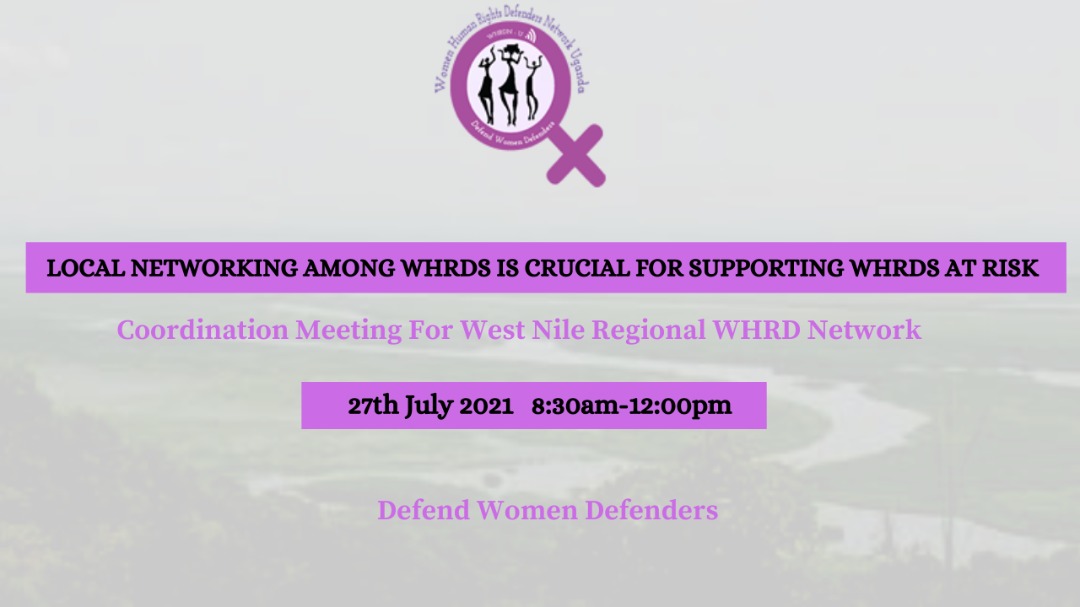
Over 9 women from Zombo, Arua, Nebbi and Adjumani districts convened in their physical locations and attended an online meeting organized by Women Human Rights Defenders Network Uganda (WHRDNU) on 27th July 2021 from 8:30am to 12pm. The theme of the meeting was “Local Networking among WHRDs is crucial for supporting WHRDs at risk.” The meeting focused on the importance of local networking in West Nile region.
In her remarks, Ms. Brenda Kugonza of the WHRDN-U welcomed members and thanked them for advocating for peace, justice and equality in the region. She further noted that WHRDs in West Nile work tirelessly to defend women, girls, land, economic and freedom of expression rights while also fighting against gender-based violence, discrimination and widow inheritance.
However, Ms. Brenda Kugonza noted that as WHRDs defend human rights, secretariat has received reports of the challenges WHRDs face such as hostility, harassment, verbal and sexual assault by state and non-state actors and that the ongoing violations can result in damaging their physical, emotional and energy levels.
The following comments from participants illustrate the current situation of the threats faced by WHRDs based in West Nile:
“People tell you remember your past before you talk to us, you lost your marriage and even failed to marry,” said Oroma Prisca.
“Cyber-attacks when defending women,” mentioned Amviko Caroline.
“Like us in the media, we are being told to first get married, they say get married before you come to talk to us, you are not even marriage material, first bring back your husband.” Mami Maimuna.
“Torture – psychological, emotional, and social,” shared Bileru Knight.
Ms. Brenda Kugonza from WHRDNU called upon the women defenders to practice self-care and healing from time to time. She noted human rights work can take a toll on their mental health and they shouldn’t reach a point of breaking down before they take a break.
In the plenary discussions, participants discussed how to improve coordination of the regional network:
“These meetings are about caring for each other.” Said Ocotuku Mercy from Arua district.
“In West Nile, I think through the coordination meetings we will share our needs in areas of protection, safety and self-care,” Asibazuyo Lilian from Arua district.
“If you are not psychologically stable, you cannot counsel someone. So, we have to take care of our bodies and mental health,” remarked Adokwin Emmanuella from Zombo district.
“We can improve coordination through having WhatsApp groups,” said Adiru Gladys.
“Facilitate dialogues at regional level between women defenders representing various social movements in our regions so that they benefit and also participate in joint actions to ensure women defenders safety and protection,” Adokwin Emmanuella requested.
Stella Biryema from Zombo district said, “coordination meetings promote the growth and building of local networks to defend women defenders at risk.”
“We get demoralized sometimes when we get attacked by our communities, it also hurts to work alone and it is important to work together, we also need someone to lead us in the region,” submitted Oroma Prisca from Nebbi district.
The women defenders were encouraged to get each other’s contacts so that they can be able to check up on each other as well as stand with women defenders at risk. Phone contacts were shared and exchanged by members during the meeting.
Members suggested having an active WhatsApp group to ease coordination and networking in the region. Building good relationships with stakeholders like the police. Maintaining and having a positive attitude when they go out to do human rights work. These were recommendations raised to help members overcome the challenges women defenders face.
Participants attending the zoom meeting in their physical locations.
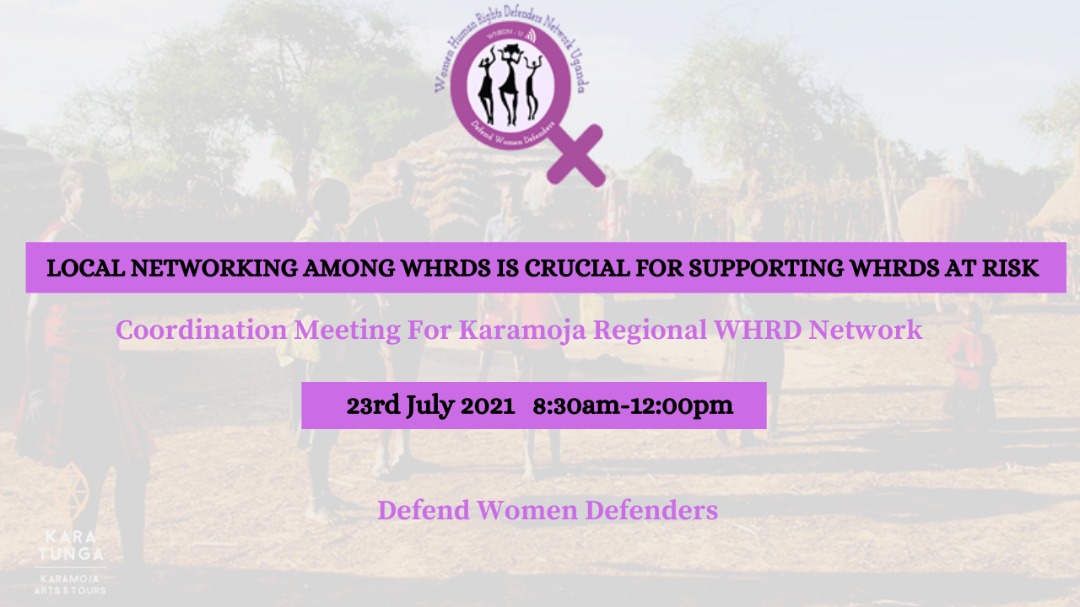
The Women Human Rights Defenders Network Uganda (WHRDN-U) seeks to support and facilitate WHRD regional network coordination. The key aim is to help improve response and the effectiveness of the local regional WHRD network mechanisms in rural contexts. On 23rd July 2021, under the theme “Local Networking among WHRDs is crucial for supporting WHRDs at risk,’’ WHRDN-U conducted a zoom coordination meeting for over 14 WHRDs as a space to help improve collective understanding around coordination, documenting incidences of attacks and reports cases of WHRDs at risk to WHRDN-U secretariat. While the meeting was online, the WHRDs converged in physical locations in Amudat, Moroto, Kaabong, Nakapiririt, Napak, Nanduget and Kotido districts of Karamoja region.
Ms. Brenda Kugonza, of the WHRDN-U outlined the meeting objective stating that the discussions will cover, situation of women defenders in the region, gathering information on attacks. submission of reports and documentation of attacks.
Ms. Brenda Kugonza, gave an overview of the situation, highlighting the human rights work done by WHRDs, the reports on challenges, threats and fears Rwenzori WHRDs received at secretariat. Ms. Brenda acknowledged that WHRDs in the region were involved in defending land rights, freedom of speech, access to information, mining and environmental rights and fighting against GBV/Violence against children, patriarchy and Female Genital Mutilation. Ms. Brenda informed participants that the WHRDN-U secretariat was receiving reports of violations against women defenders in Karamoja region notably; restrictions on their freedom of expression, state actors’ refusal to recognize the work of women defenders in the region, infringing on their right to association and lack of appreciation of the work of WHRDs from their communities, discrimination and intimidation. She further inquired if some participants were experiencing similar challenges & threats. With regards to threats and challenges, below are WHRD’s voice;
Sending threatening pictures like a man holding a gun, shared Alosikin Merab from Amudat district.
Restrictions on access to information ‘sometimes you go to police to defend someone and they don’t give you any information’ said Nambuya Fiona from Moroto district.
Threats of losing marriages and not being married – ‘husbands are always told that they can’t control a woman who is a WHRD’ revealed Mary Lopuka from Nakapiririt district.
When you are sensitizing communities about FGM, they tell you, you must be a victim of FGM that is the reason why you know all about it, mentioned Cepohysiyo Janet from Amudat district.
In addition, participants were informed that they face a variety of problems related to their mental and physical health. In particular, the issues related to showing signs of fatigue, exhaustion and stress which indicated lack of self-care for themselves. Brenda Kugonza asked why WHRDs neglected their own self-care & wellbeing. In response, Dorcus Chelain from Amudat district said ‘’we feel guilty to take breaks yet our people need us- sometimes we are overwhelmed with many sad cases that need our urgent attention.’’ Thus, the meeting highlighted the importance of selfcare and well-being and recommended that WHRDs learn to take off breaks for their own self-care and healing in order to avoid burn-outs, stress and also relax to feel better. For instance, “let’s create healing spaces for women defenders in regions to remove stress and traumas,’’ said Joyce Chemutai from Amudat district.
In conclusion, the meeting provided a great platform for dialogue and collaboration to review the need for stronger local support networks for WHRDs. The participants formulated recommendations to improve coordination, networking and support WHRDs at risk. They included;
Timely reporting of incidence of threats against WHRDs to WHRDN-U secretariat
Members suggested to have regular coordination meetings
Requested WHRDN-U team to visit regions when COVID-19 lock down measures are eased to provide on-site mentoring support to regional focal persons.
Exchanged telephone contacts to maintain communication and sharing of information
“Regional networks will help denounce violations against women defenders”, said Amiya Shannon from Napak district.
“Regional coordination meetings will help to promote recognition of women’s work and contribution in human rights.” Dorcus Chelain of Amudat district.
Members shared contacts during the zoom meeting as seen below.
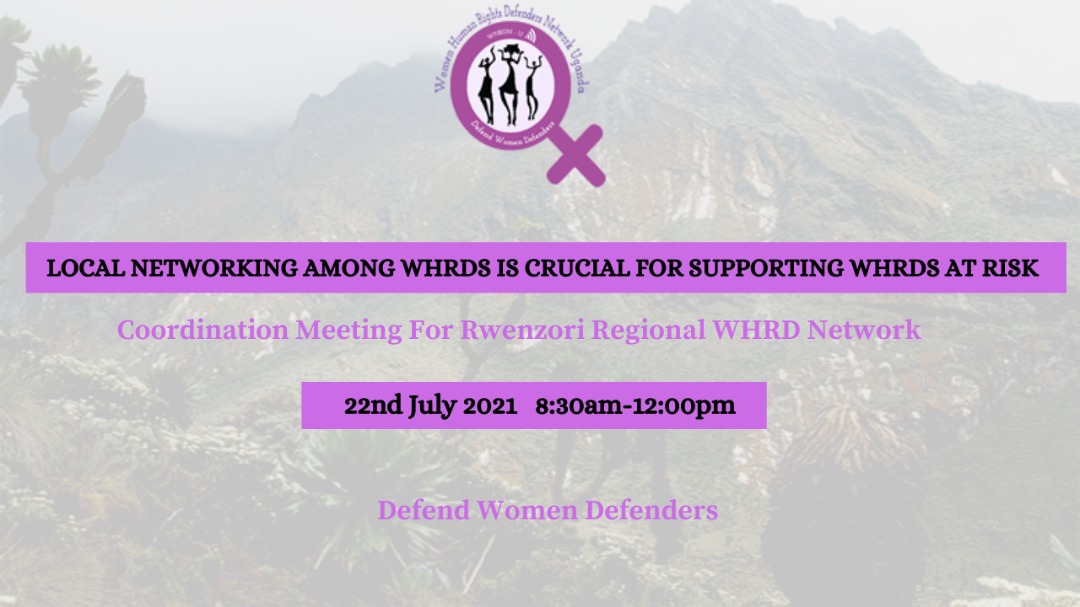
On 22 July 2021, the Women Human Rights Defenders Network Uganda (WHRDN-U) convened a zoom coordination meeting for WHRDs based in Rwenzori region under the theme “Local Networking among WHRDs is crucial for supporting WHRDs at risk.” The meeting attracted over 18 women defenders who gathered in their physical locations from Kasese, Kabarole, Katwe, Bundibugyo, and Bulisa districts.
The coordination meeting aimed at improving the capacity of grass root regional WHRD networks to protect women human rights defenders at risk. It also provided a platform for women defenders to share their experiences of threats, fears and challenges faced in defending human rights work.
Women human rights defenders participating in the meeting had this to say about their experiences of threats, challenges, fears and attacks
“Some people abuse us that If you failed to manage your own children whose child, do you think you will manage, why are you interfering with our culture.” Kyobutungi Maureen of Kabarole district.
“Detention of WHRDs – ‘someone times you come in as a defender you are also arrested without even fair hearing.” Mawa Juliet Masika of Katwe district.
“I have received threats of rape, office break ins, and telling me to reduce my voice or I will die because of defending rights of sex workers.” Rose Kahunde of Kasese district
For her part, Ms. Brenda Kugonza thanked women defenders for their resilience and commitment to defending human rights noting that women defenders from Rwenzori region worked on a wide range of areas- rights of sex workers, rights of indigenous people (Batwa), women’s rights, land rights, business and human rights, environmental rights and working to dismantle patriarchy moreover in extremely difficult contexts and circumstances. In her remarks however, Ms. Brenda Kugonza informed participants that throughout the period of Lockdown, WHRDN-U secretariat received reports showing the challenges faced by members of Rwenzori WHRDs Network including:
Emotional blackmail
Discrimination against women defenders by duty bearers
Being branded as immoral women corrupting society.
And their meetings/gatherings being dispersed by duty bearers.
Speaking at the meeting, Kabagenyi Peluce, the focal person concurred with Ms. Brenda’s report of the challenges they were facing and thanked WHRDNU for organizing the meeting to ensure that their pertinent issues were heard and addressed.
In her presentation concerning how to improve the local network in the region, Ms. Brenda Kugonza, of the WHRDN-U, encouraged women defenders to document incidences of attacks against women defenders noting that documenting brings visibility and legitimacy to the work and contributions of women human rights defenders. She further noted that documenting allows us to record our experiences as human rights defenders and as women that if there is no record of the violations inflicted upon women defenders, the violations will not be known by the public. By the end of the meeting, WHRDs demonstrated the ability to coordinate grass root WHRDs, document attacks, and report cases to secretariat, when they gave the following proposals regarding collaboration, coordination and documenting and reporting cases of attacks against WHRDs.
They committed to opportunities of collaboration when they exchanged phone contacts. Members shared their phone numbers in the chat during the zoom meeting. They also suggested that they create a social media platform for the Rwenzori WHRDs Network.
“Coordination can surely improve if only we can keep in touch with each other and our district focal persons.” said Jacklyn Bwenge of Kasese district.
“Thank you, WHRDN-U, through the coordination meeting you will help provided a shared understanding of the violence women defenders face in our region.’’ Kabalisa Rhoda of Bundibugyo district
‘’We need to have forums like this to encourage mobilization of women defenders to come together leading to a smooth flow of information between secretariat and the region,’’ said Peninah Zaninka from Kisoro district.
“In these meetings I get to know the sufferings of our sisters.” Peluce Kabagenyi of Rwenzori
The meeting also involved discussions on self-care and well-being. During the meeting, it was empathized that WHRDs need to take care of their mental and physical health through taking off time to rest and relax. Meeting as a Network for leisure activities like having dinner. Participants went ahead to discuss the toll of stress, trauma and social exclusion on their mental health as there is a lot of stigma faced at community level. ‘’This leads to risks such as mental breakdown and distress due to psychological torture.” Musoki Elizabeth of Kasese.
Members gathered in physical locations to attend the zoom meeting.
We use cookies to ensure that we give you the best experience on our website. If you continue to use this site we will assume that you are happy with it.