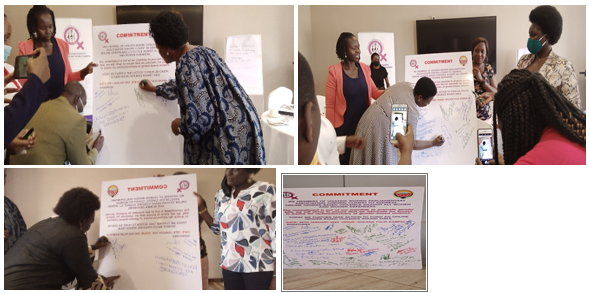
Sarah Opendi, chairperson uwopa signing the commitment

WOMEN MEMBERS OF PARLIAMENT COMMIT TO FIGHT ONLINE VIOLENCE AGAINST WHRDS.

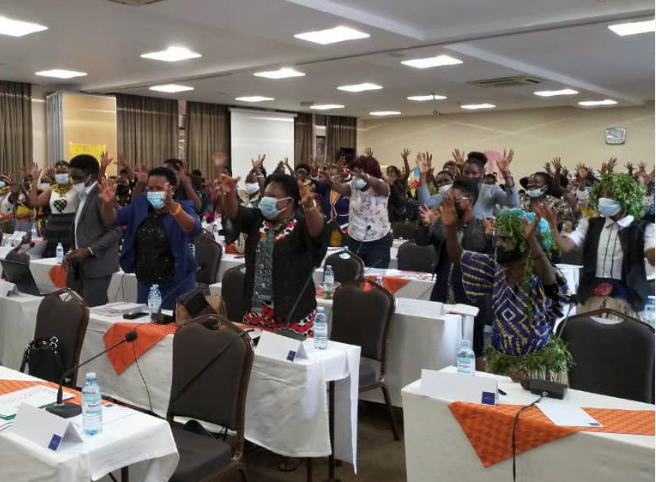
Executive Women Members of Parliament were called upon by Women Human Rights Defenders (WHRDS) to advocate for Gender inclusive bills as a means to strengthen the security of WHRDS in Uganda. This was during the breakfast meeting organized by Women Human Rights Defenders Network (WHRDN-U) in partnership with UWOPA on 28th January, 2022 at Golden Tulip which aimed at raising awareness on gender-based concerns for WHRDS.
Speaking at the meeting, Ms. Mary Harriet Lamunu, Executive Director UWOPA explained that the breakfast meeting was to happen in 2021 but due the absence of their chairperson who had travelled to Arusha, it was extended to January 2022. She thanked the WHRDN-U team for engaging with them and promised to continue engaging with more MPs to handle issues that affect the women human rights defenders.

The Executive Director UWOPA giving her welcome remarks during the workshop.

In her remarks Brenda Kugonza, the Executive Director WHRDN-U mentioned that the shrinking space has impacted on the work of WHRDs. By working with the parliament, will create a safe working environment for WHRDs. She illustrated how WHRDN-U defends the women human rights defenders who defend the rights of land, the disability, LBQT and sexworkers, female journalists, and ethnic indigenous. Brenda further clarified that patriarchal is real, Female MPs are attacked when defending the laws and acts that protect women.

Sandra Kwikiriza from Her Internet told the congregation how online violence has affected many women including WHRDS. She asked members of parliament to ensure their security online by not sharing certain information related to their private life online and hide their passwords with others. “There is no good reason for me to share my email/ social media password. In reality, most of us share our passwords with our partners. I don’t have to share my password because someone can log in my account and misuse my platform”.

Sandra Kwikiriza facilitating on online violence

Members of Parliament also gave their opinions on online violence and how they have been in their leadership roles. Hon. Betty Naluyima commented that online violence is happens in the real life and she has been a victim when she was attacked online, by her opponents. “Regardless of the violence, “we will not stop” this is a crucial war and we want them to listen. We can’t give up any time no matter what happens”.
“Gender stereotypes affect women more when it comes to violence and threats online. For example, women receive more negative comments than men when it comes to sharing same information online”. Hon. Okia Joanne.

Hon. Members of Parliament expressing opinions on online violence

WHRDS shared testimonies on how they had been attacked online because of their human rights work. “During lockdown, teenage pregnancy cases were very high. It so happened that a young girl was defiled by a 40-year-old man and I shared this on Facebook, instead people abused me and this put me down. I regretted why I had put the story there”. Mwanje Caroline, WHRD from Kagadi.
“As a female journalism during lockdown, I posted stories of defilement and called for dealing with men who can’t control their sexual desires. Because I posted what people didn’t like, I was insulted, and humiliated for not having a man. I thought of leaving Facebook”. Sarah Chekwech, WHRD from Kapchorwa.

“When women with disability post pictures of our work, we are harassed. I campaigned on Facebook about a family that planned to steal land of a widow. I almost relocated because of attacks on my body. People said my body is ugly, unattractive, and that I should hide instead of exposing it on Facebook and in public. I am happy that I supported the woman amidst intimidation”. Peluce Kabagenyi, WHRD from Kasese.

“As a female journalist, in 2021 during lockdown, when I posted stories of defilement and called for dealing with men who can’t control their sexual desires and because I posted what people didn’t want, they harassed me, they went below my belt attacking me for not having a man, I sated thinking of leaving Facebook”. Goretti kajumba, WHRD from Kabarole.

“My colleague was attacked online for her activism work in the mining in Moroto. They used photo shop to put her head on a naked woman and it went viral. We later found out that our colleague’s bottom parts had a scar and the photo posted had no scar”. Flavia Aballo, WHRD from Kampala.

WHRDS testifying how they have encountered online violence in their human rights work.

“I was hosted on a talk show to discuss GBV in Busoga, men attacked me on social media saying that am not supposed to comment on marriage issues because I am not married. They used messages such as ‘The spoilt girl should not mislead you’ to humiliate me”. Kyemba Rosemary, WHRD from Jinja.

In her speech, Hon. Sarah Opendi the Chairperson UWOPA thanked WHRDN-U for being a back a backbone of women huma rights defenders and encouraged the network to continue carrying on human rights work. She testified how she has been a victim of online violence, which is why she is not on Facebook. Someone created an account in her name, and promised people jobs and stole money from them.

Hon Sarah, further shared she was attached on social media for advocating for the rights to safe abortion. We must continue until we reach where women’s rights are respected and also where women and girls are not looked at or perceived as sex objects. She also mentioned that they will be bringing back the marriage bill to parliament and more amendments will be made like from woman MP. We are also bringing forth the Surrogacy bill. Infertility is not a matter for women alone but also a man’s issue.

The Executive a pledged to support WHRDS through working with WHRDN-U to promote safety and security on WHRDS in Uganda and advocating for gender responsive bills in members through signing a commitment form at the breakfast meeting.

Sarah Opendi, chairperson uwopa signing the commitment
Sarah Opendi, chairperson UWOPA signing the commitment

Hon. Members of Parliament signing on a commitment board to advocate for gender responsive bills during the breakfast meeting.
ONLINE AND OFFLINE SAFETY AND SECURITY GUIDELINES FOR WHRDS IN UGANDA

On 29th November 2021, Women Human Rights Defenders Network Uganda (WHRDN-U) in partnership with the UN Women Uganda, and the Office of the High Commissioner for Human Rights (OHCHR), launched the safety and security guidelines as a strategy to strengthen the capacity of Women Human Rights Defenders (WHRDS) to mitigate the impact of gender-based violence against their work.

WHRDS and their networks continue to face specific risks and are often targets of serious abuses due to the nature of human rights work they do. They therefore require enhanced protection from attacks at all levels. Unfortunately, this is not the case in Uganda as there are no clear policies to protect WHRDS.

It is from this context that WHRDN-U together with UN Women and OHCHR developed safety and security guidelines to enhance the protection of WHRDS by providing practical safety measures.

The guidelines for WHRDS presents the best practices both online and offline, highlighted in sections 3, 4 and 5, recommendations and key considerations also highlighted in section 6. The best practices are discussed below;

  • Individual WHRDS are encouraged to join the networks for solidarity, enhance their accountability and understand how to operate online, be conscious of their security all times, safeguard all evidence and report cases.
  • WHRDS organizations are encouraged to develop and implement a security plan, nurture space to speak up, use collective care, wellness approach, and adopt to technology for online activism and rapid response.
  • Social movements are advised to develop a database for referral of services, create support spaces at district and regional levels, and alliance building with like-minded actors.
  • The guidelines also provide digital and social media mechanisms to help WHRDS and their organizations prevent online violence such as use of Anti-Virus and Anti-Spyware protection, managing social media and phone settings, blocking abusers by using social media features such as unfollowing/unfriending, reporting and muting among others.

Furthermore, the guidelines offer recommendations for the key actors in the protection of WHRDS such as;

  1. WHRDN-U: To establish a clear referral pathway for WHRDS, foster safe networking space for WHRDS, expand online activism, and equip WHRDS with knowledge and skills on human rights work including knowledge on ICT and put in place an emergency fund to address issues of WHRDS.
  2. UN Women, OHCHR and other partners: To support recommended actions to push the implementation and effective utilization of these guidelines, set up an emergency fund that addresses the unique gender attacks and violations that WHRDS face and prioritize support for self-care, wellness and healing justice for WHRDS
  3. WHRD Networks, organizations, and CSOs: To institute internal institutional WHRDS programs and interventions aimed at enhancing institutional safety mechanisms, safety protocols and staff capacities.
  4. State Actors, Non-State Actor and Communities: To enact enabling laws that curb violence targeted at WHRDS such as POMA, Computer Misuse Act, Penal Code and Sexual Offences Bill that are often used to violate WHRDS and address impunity at institutional and community levels.

To access a copy of the Safety and Security Guidelines for WHRDS click here.

WOMEN HUMAN RIGHTS DEFENDERS SUPPORTED TO DO THEIR ROLE IN THE COVID-19 CONTEXT IN 2021.

The COVID-19 pandemic disrupted the human rights defense work of WHRDs in Uganda, who work to protect human rights for all, create peace, gender equality, and ensure that justice is served for SGBV survivors.

Global Fund for Women (GFW) stood in solidarity and ensured that WHRDs continued their activism. GFW provided WHRDs – frontline defenders with essential supplies through the Crisis Fund. These supplies included; safe transport, food, face masks, hand sanitizers, communication (became a basic need in this crisis) and types of support were related to phone-recharging, purchase of credit, cell phone. Thereby facilitating them to mobilize, organize, reach out to various communities and support online activism as some WHRDs wanted to move online (WhatsApp, Facebook & Twitter) to do their activities. Read stories below of how the fund helped WHRDs to do their work in Uganda: 


Ms. Juliana Among, Ms. Napiyo Madalena and Ms. Nabong Margret of the Ik ethnic indigenous minority group, used the relief funds for transport to go and register their group to legally operate in Kamion subcounty, Kaabong District. They were able to continue with promoting the rights of IK indigenous communities.

A copy of the recommendation letter to attain a certificate of registration being signed.

Ms. Edreda Dogolo, Ms. Grace Mbatina, and Ms. Rhoda Kabalisa the Batwa indigenous minority WHRDS from Bundibugyo, used the funds to organize Batwa women for a sensitization meeting on their rights to access the semiliki forest as their ancestral land. They also distributed food to Batwa women.

Ms. Roda Kabalisa a WHRD carrying out an awareness sensitization meeting in the Batwa Community

Robinah Tibakanya a WHRD from Hoima district used the relief funds to buy airtime for communication and stationery which she used to carry out the sensitization meeting to women in Namasagali village on land rights.

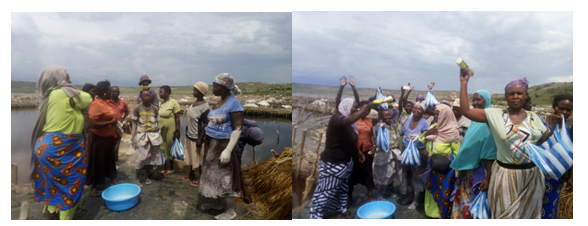
Ms. Mawa Jacky and Ms. Nasaka Halima, the WHRDS from Katwe salt mining the covid relief to distribute food to female salt miners in Kasese district.

Moreen Kyobutungi and Faridah Kugonza, WHRDS from Kabarole district used the relief funds to purchase food and soap which they distributed to the female sex workers for sustainability during the pandemic.
Ms. Amono Jackline and Ms. Angeno Rose, from Mighty fire FM used the Covid relief to buy face masks and sanitizers which they supplied to fellow work mates. They appreciated WHRDN-U for the support that enabled them to continue carrying out their journalism work.

Ms. Amek Joan a WHRD from Central region, used the Covid relief to reach out to Rella House of Hope. She purchased pads and soap which were distributed to LBQT residing in the shelter.

 Christine P’ochan a WHRD from Acholi used the covid relief support to pay a solidarity visit to Akol Winifred one of the WHRDS who had been attacked ,They too bought food for her.

Christine P’ochan a WHRD from Acholi used the covid relief support to pay a solidarity visit to Akol Winifred one of the WHRDS who had been attacked ,They too bought food for her.

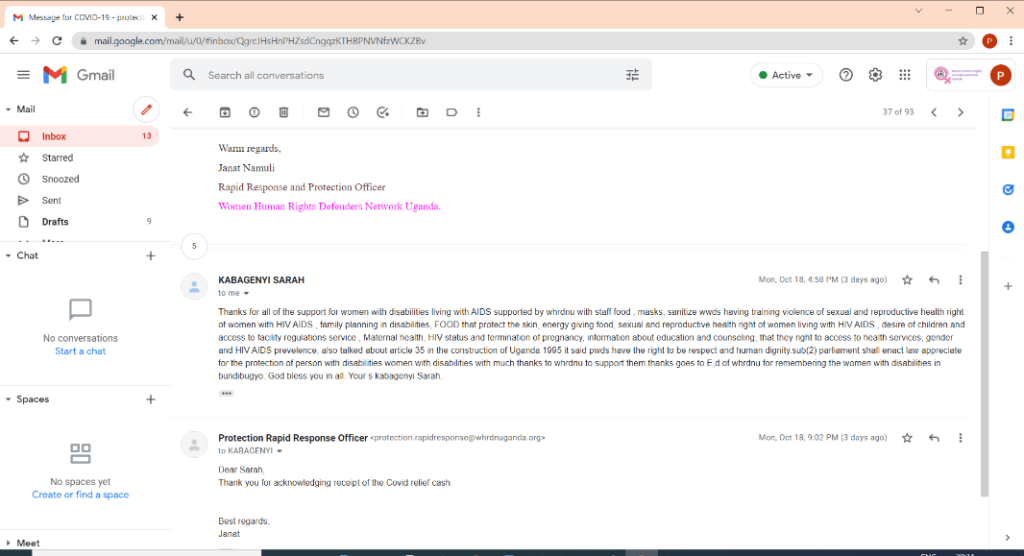
Ms. Sarah Kabagenyi, WHRD defending the rights of people with disabilities in Bundibugyo district used the Covid relief to mobilize women with disability and  living with HIV to understand how and where to access family planning and Reproductive health services .
Ms. Sarah Kabagenyi, WHRD defending the rights of people with disabilities in Bundibugyo district used the Covid relief to mobilize women with disability and living with HIV to understand how and where to access family planning and Reproductive health services .
Ms. Paulin Chepar an anti-Female Genital Mutilation activist under Sanayi Anti FGM movement in Amudat district of Karamoja region bought a smart phone using the covid relief money to enable her to continue with the Anti FGM campaign documenting stories and reaching out to girls escaping FGM.

Ms. Naduke Betty, a GBV activist in Kabong district during a meeting with women who had reported cases of Domestic Violence (DV) , used relief fund to give out soap to survivors of DV
Ms. Nabiira Ndagire( holding a copy of the Domestic Violence Act) of Tusitukirewamu women empowerment group in Bwaise. Used relief fund to give food, while talking to women that the  DVA encourages them  to report DV to police, health workers and courts of law.
Ms. Nabiira Ndagire( holding a copy of the Domestic Violence Act) of Tusitukirewamu women empowerment group in Bwaise. Used relief fund to give food, while talking to women that the DVA encourages them to report DV to police, health workers and courts of law.

WHRDS TRAINED IN INTERNATIONAL HUMAN RIGHTS MECHANISMS FOR PROTECTION.

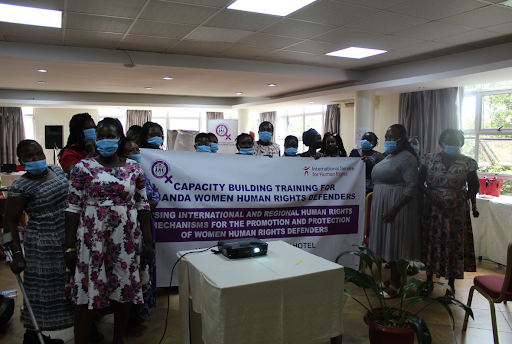
Women Human Rights Defenders Network Uganda (WHRDN-U) in partnership with International Service of Human Rights (ISHR) held a three days workshop that engaged 23 WHRDS with relevant human rights protection mechanisms at Esella Hotel in Kampala, from 5th to 7th October, 2021.

The workshop aimed at equipping WHRDS with skills on relevant human rights protection mechanisms and mapping out opportunities for advocacy. It was also an opportunity to foster coordination and networking among members.

Brenda Kugonza, the Executive Director for WHRDN-U began the workshop with highlights on the role of the network as an umbrella that was formed to protect women who defend the rights of others. She emphasized that the network came together to respond to specific individual or collective cases of violation of rights of WHRDs at risk.

Brenda facilitating during the training

Hannah Sobocinski, the training and advocacy manager for ISHR briefed participants on human rights mechanisms at international and regional level which defenders can collaborate with. These included the Human Rights Council, the Universal Periodic Review, the Special Procedures and independent experts, and the treaty bodies.

Hannah further explained the role of regional human rights instruments (treaties, conventions, and declarations) that it helps to localize international human rights norms and standards, and the regional human rights mechanisms (commissions, special rapporteurs, courts) that implements these instruments. She added that African Charter on Human Rights, an institution was formed in 1986,  has been a significant in promoting human rights through declaring 21 October every year celebrated as an International Human Rights Day.

Pooja Patel, the programs director of ISHR also led a session on the human rights mechanism. She described The United Nations’ Convention on the Elimination of all forms of Discrimination against Women (CEDAW) as the international bill of rights for women in civil, political, economic, social, and cultural fields whose role is to set up an agenda for national action to end discrimination against women.

With the support from the discussions, WHRDS recognized I need to advocate for the implementation of advocacy objectives to engage with international mechanisms.  They recommended the following objectives;

  1. Parliament of Uganda to enact gender-responsive laws
  2. Expand WHRDS network for international solidarity
  3. Advance WHRDS agenda at the international community


Participants discussing the advocacy objectives to engage with key stakeholders.

They also mapped out key stakeholders to influence and a time frame. Facilitators advised that it was vital for them to look beyond the human rights defenders’ bill, and that they should not be limited by time as issues of WHRDS are worrying and therefore requires urgent action.


Screenshot showing advocacy objectives which participants designed.

WHRDS TRAINED TO USE VISIBILITY FOR PROTECTION AGAINST VIOLENCE.

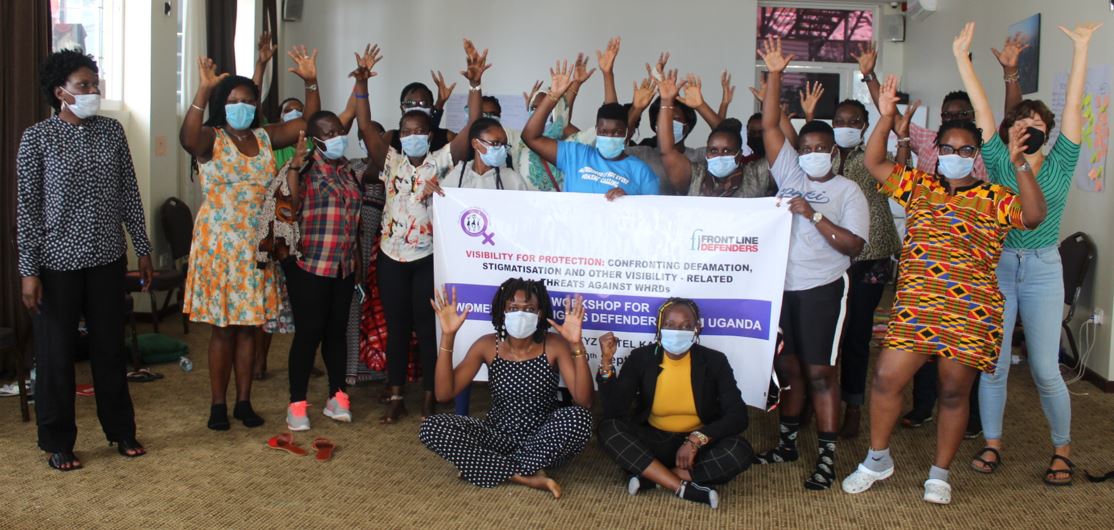
From 21st to 25th September 2021, Women Human Rights Defenders Network Uganda (WHRDN-U), in partnership with Frontline defenders, conducted a workshop on visibility for protection of 21 WHRDS at Sky’s Hotel in Kampala. The specific objectives were to reflect on the multi-layered aspects of visibility and the protection methodologies for WHRDS.

During those five days, WHRDS discussed how visibility has affected their work, the gender specific threats, strategies to respond to those threats, and shared their experiences on the visibility for protection.

The first session of the workshop marked interventions from Marie San Martin, advocacy manager for Frontline Defenders. Marie explained what visibility means and its impact on the work of WHRDS noting that visibility is fundamental feature for WHRDS as it promotes their work. One participant shared that visibility has helped her take back her power as a woman defending rights of sex workers. She has set the pace for other sex workers to also speak out and defend their rights. Another participant noted that visibility is important for resource mobilization since donors are interested in seeing progress of their work.

Marie San Martin leading a session during the visibility for protection workshop.

The second day led by Brenda Kugonza focused on identifying gender specific threats against WHRDS. She mentioned that threats such as, defamation, smear campaign, stigmatization and online violence are being used to harm their reputation. One of the participants mentioned that she has been named ‘a prostitute’ by the community. “Look at you, do you also have children? you don’t deserve them, you are only a prostitute’’- she expressed.

Brenda Kugonza facilitating on gender-specific threats during the workshop.

The third day of the workshop involved participants brain storming on protection strategies they can use to respond to risks and attacks they face. They also drafted action plans that analyzed risks they face. The action plans elaborated measures they can use for their visibility such as;

  • Sensitization and information
  • Temporary relocation
  • Disclosing to their families the work they do
  • Increase legal capacity
  • Self-care and seeking counseling.

Participants drawing action plans on how they will protect their visibility. 

The fourth day focused on digital security management and the intervention of internet.  Sandra Kwikiriza, the Executive Director at Her Internet, told participants that there is a need for them to tighten their digital and physical security. She encouraged WHRDS to use the following digital safety tips

  • Data backup
  • Strong passwords
  • 2 factor authentication
  • The Onion Rouser browser. 

The fifth day marked the end of the workshop with a session on online violence by Hellen. She highlighted the new forms of violence including sexual harassment, cyber stalking and hate speech, mentioning that they are frequently terrifying and have manifested to physical violence. She enabled group discussions where participants identified the following digital security tips;

  • Installing cameras in their workplace,
  • Keeping information confidential
  • Monitoring their movements.
  • Change of office locks

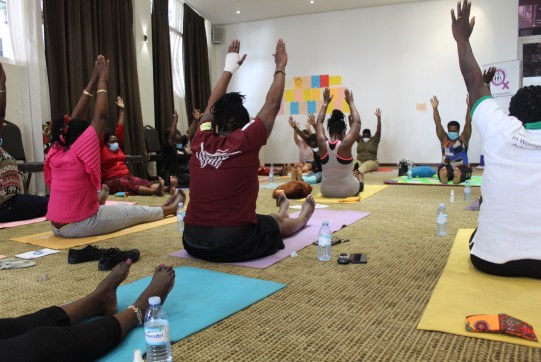
During the workshop, participants hard a self-care and wellbeing session.

FEMALE JOURNALISTS WHRDS TRAINED IN ONLINE VIOLENCE AND DIGITAL SECURITY MANAGEMENT.

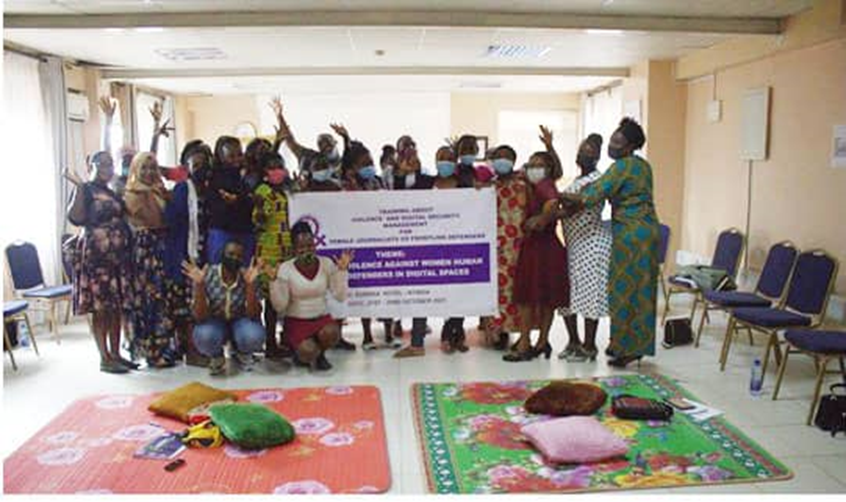
Female journalists WHRDS were asked to consider digital security crucial as a means to protect themselves from online attacks. This was during a two-day training of 20 female journalists from different media houses, organised by Women Human Rights Defenders Network Uganda (WHRDN-U) at Eureka hotel in Ntinda, on 21th to 22nd October 2021.

Female journalists working as frontline defenders face a lot of challenges attributed to gender stereotypes. The training, aimed at equipping them with knowledge on how to report and respond to the attacks they face online while executing their work.

Ms. Amwiko Sarah, a journalist at Radio Pacis in Arua district expressed that she wrote a story about her friend who is lesbian but her news editor denied it to be aired. Even when she held a talk show with a topic “Rights of different sex desires”, people on social media accused her of supporting immorality.

Ms. Kalungi Rachael, a journalist at B FM explained that she has faced online threats from her ex-boyfriend who helped her to create a Facebook account. After they broke up, he changed the password and currently, he is controlling it. Of recent, he posted nude pictures on that page.

Ms. Karungi (in a white and black dress), explaining her experience on online gender-based violence.

Ms. Kwikiriza Sandra, a facilitator of digital security management enabled journalists to install the most recommendable Virtual Private Network (VPN) and Signal App saying that they help to promote anonymity of a user and demonstrated how they can create strong passwords. “There is need to use strong passwords with over 15 characters including capital letters and special characteristics and activate two-factor authentication, as this prevents hackers from accessing your accounts because one receives a notification whenever someone else tries to login their accounts from another device”.

Ms. Kwikiriza advised female journalists to prioritize their safety through safety precautions such as;

  • Safer devices,
  • Trusting their instincts
  • Identifying the abuse
  • Documenting incidents to show to the police

Ms. Kwikiriza facilitating on digital security management.

Ms. Amuge Peace, an online gender-based consultant guided the journalists on how to understand the new forms of violence such as cyber stalking, defamation/hate speech, and nonconsensual creation of sexual images and how they have led to psyco social, physical violence and economic loss among women human rights defenders. She encouraged journalists to stay calm and not give up on their duties, but to be conscious of their security while using internet.

Ms. Amuge facilitating during the female journalists training.

Some of the female journalists presenting during the online gender-based violence session.

As a means to end online gender-based violence among WHRDS, female journalists were encouraged to transfer knowledge and skills to colleagues in their respective organizations. In our tweet here Sarah Amviko, a female journalist from Pacis FM in Arua shared the knowledge and skills she acquired with her workmates.

DISTRICT FOCAL PERSONS WHRDS TRAINED IN ONLINE GENDER-BASED VIOLENCE AND DIGITAL SECURITY MANAGEMENT.

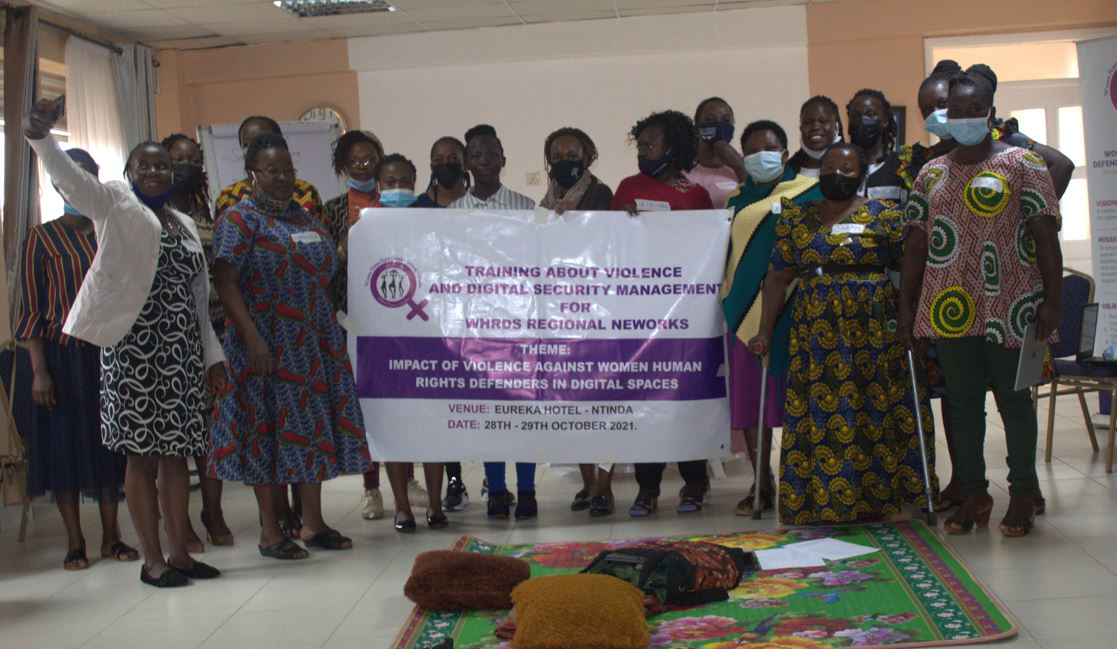
20 district focal persons from Karamoja, Albertine, Rwenzori, West Nile, and Acholi regions of Uganda acquired skills on online gender-based violence and digital security management as a mean to protect themselves against online gender threats in their work. This was during a two-day training, organized by Women Human Rights Defenders Network Uganda (WHRDN-U) at Eureka hotel in Ntinda, on 28th to 29th October 2021.

While leading a session on digital security management, Ms. Kwikiriza Sandra, encouraged participants to prioritize their safety through using practical tips such as;

  • Installing virtual private networks
  • Setting strong passwords
  • Activating two-factor authentication
  • Backing up data
  • Identifying the abusers
  • Reporting cases of violence to authorities.

Ms Kwikiriza demonstrated how the internet operates. “When one sends a message to another person through a device, it passes through internet service provider 1(ISP1) like Airtel or MTN who then connects to the WhatsApp or website then back to Internet Service Provider 2(ISP 2) where the message is being sent.’’

Ms. Kwikiriza Sandra facilitating on digital security management during the district focal persons WHRDS training.

Ms. Amuge Peace, while facilitating on online gender-based violence advised participants to be aware of digital hackers and stay vigilant when using internet. She explained that the misuse of digital tools has opened doors to new forms of abuse such as cyber bullying, defamation, doxing and sexual harassment. This has caused distress, trauma, and depression to victims including WHRDS.

Ms. Asubazuyo Gertrude, a WHRD from Albertine region shared that, “News came from one of my WhatsApp groups of a man who was found beating his wife in the market accusing her of not staying home to cook. When I condemned this act, people abused me in comments saying that this matter does not concern me. Another person commented, ‘no wonder you are not married’’.

Ms. Lopuka Mary, a WHRD from Karamoja region revealed that, she got shocked when together with her colleagues reached at work in the morning and opened their computers only to find a pornography movie.

Gertrude Asubaziyo (third from left), a WHRD from Masindi district in Albertine region sharing her experience on online gender-based violence.
Mary Lopuka, a WHRD from Nakapirit district in Karamoja region explaining her experience on online gender-based during the training.

Participants were encouraged to transfer knowledge on online gender-based violence and digital security skills to colleagues in their respective organizations. In our tweet here, Ms. Sange Jackeline, a WHRD from Kween district, Eastern region trained two of her colleagues in the Benet Community.


WOMEN HUMAN RIGHTS DEFENDERS NETWORK UGANDA APPRECIATES MEDIA’S SUPPORT IN THEIR WORK.

Women Human Rights Defenders Network Uganda (WHRDN-U) is deeply indebted to the media for the great work of setting the agenda to support the work of women human rights defenders in ending violence against women and girls.

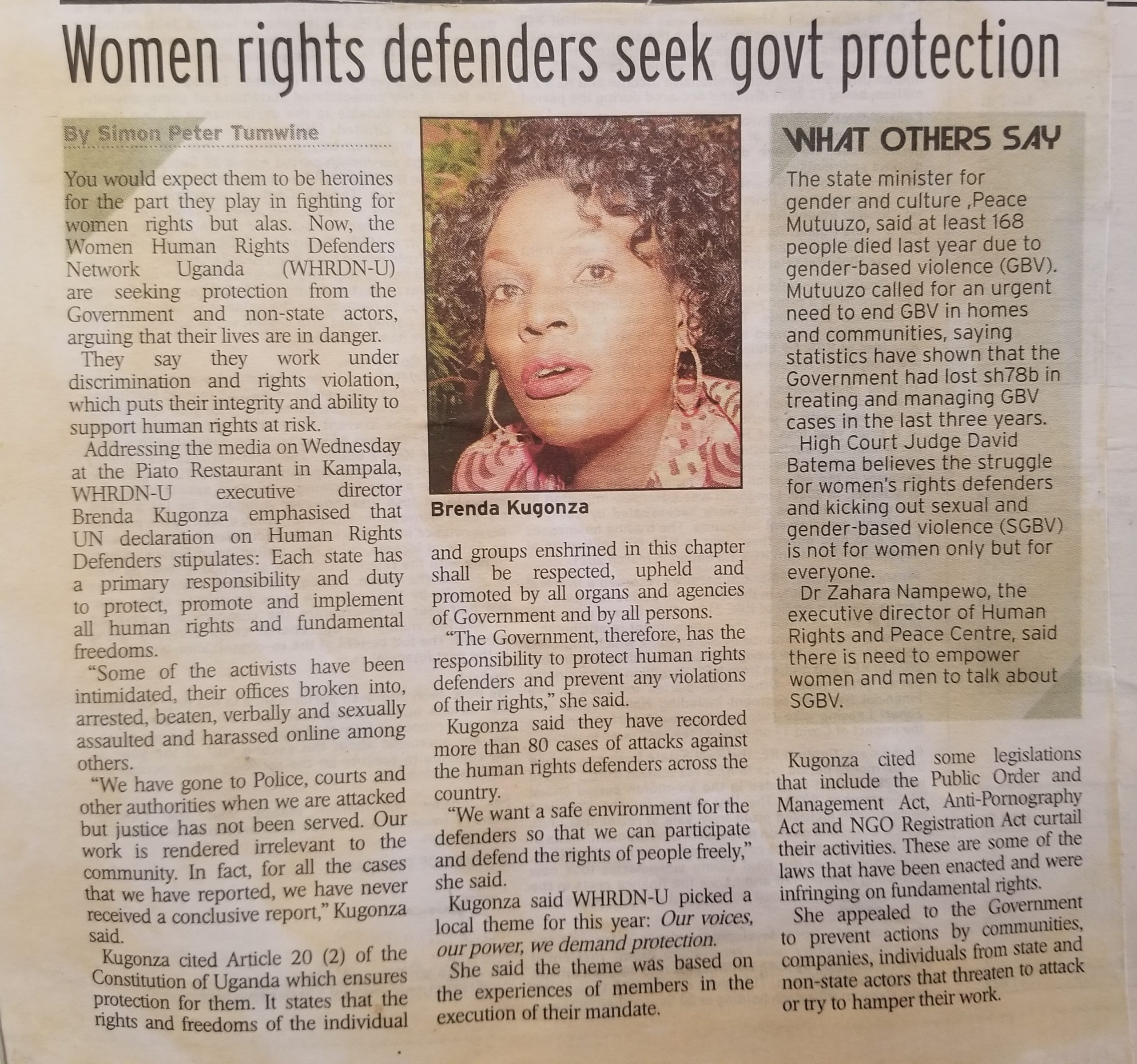
On 24/11/2021, our Executive Director Ms. Kugonza Brenda addressed journalists on the situation of women human rights defenders at Piato Restaurant, Kampala. On 30/11/2021, her message was published in the New Vision, and featured in one o’clock news bulletin, at 107.8, Aulogo FM, in Adjuman District.

Click here to read more about Ms. Brenda’s story in the New Vision.

The news bite that was aired on 107.8, Aulogo FM.

As our mandate to ensure a free and safe work environment for women human rights defenders, we continue to condemn all forms of violence against women and girls. We also seek government protection for all women human rights defenders in Uganda.

Women human rights defender having a fun time during the launch.

COMMEMORATION OF 29TH NOVEMBER 2021 INTERNATIONAL WOMEN HUMAN RIGHTS DEFENDERS DAY

As the world commemorated the International day for women human rights defenders on 29th November 2021, Women Human Rights Defenders Network Uganda (WHRDN-U) jointly with UN Women, oriented this year’s campaign and launched the safety guidelines as move to strengthen the protection women human rights defenders against violence.

Speaking at the launch at Protea Hotel, Ms. Anna Marrifield, the Deputy Ambassador European Union Delegation to Uganda and the chief guest, appreciated all women human rights defenders for not giving up amidst the challenges they face while executing their work. She urged women human rights defenders to take note of these guidelines and use them for self-protection against violence. She appealed to the policymakers of Uganda to consider these guidelines in the 11th Parliament

Ms. Anna Marrifield, the Deputy Ambassador EU Delegation to Uganda (on the right) and Ms. Kemi, UN Women representative (on the left) during the launch

While presenting the safety guidelines, Ms. Nakaweesi Solome, a Pan-African feminist, who took a lead role in developing these safety guidelines, thanked WHRDN-U, UN Women, and other partners for the great work in the protection of women human rights defender. “We took time to consult women human rights defenders from four regions of Uganda, that is North, South, East and West. Some of these women are here with us, thank you for providing us with the information which led to the compilation of these safety guidelines”. Ms. Nakaweesi revealed.

Ms. Nakaweesi Solome, an international consultant and a human rights advocate presenting the safety guidelines during the launch.

The Executive Director of WHRDN-U, Ms. Kugonza Brenda, in her remarks, called for an urgent need to end gender-based violence among women human rights defenders, revealing that most of them have been arrested, beaten, discriminated, sexually assaulted, and cyber harassed, which has made their work difficult. She called upon women human rights defenders to pay attention to self-protection and committed herself to leading the network in the implementation the safety guidelines.


During the inspirational experience session, Ms. Edreda Dingolo, a defender for the Batwa tribe in Bundibudyo district, called for the protection of ancestral land and unique violence against Batwa women and girls. “There is a stereotype in our community that you can cure yourself of HIV by sleeping with a woman from Batwa, so we are often raped. She added. Ms. Halima Nalongo a defender for land, environmental, oil and extractives, also expressed her concerns on the rising threats and arrests among women working in salt industry related to land grabbing and access to justice in her region.

Ms. Edreda Dingolo (on the right), a defender for Batwa tribe in Bundibudyo distrct, Ms. Halima Nalongo (in the middle) a defender for land, environmental, oil and extractives, and Ms. Chelian Dorcus (on the left), a defender fighting FGM and early marriages in Amudat district express themselves during the launch.

Mr. Thomas, a representative from EU Delegation to Uganda, who officially launched the safety guidelines, in his remarks, thanked WHRDN-U, UN Women, and other partners for initiating these guidelines and encouraged women human rights defenders to use of them.

Mr. Thomas (on the right), a representative from EU Delegation to Uganda speaking to women human rights defenders during the launch. On the right, WHRDN-U board chairperson Ms. Margaret Kyemba signing on the launch paper.

ABOUT THE SAFETY AND SECURITY GUIDELINES FOR WOMEN HUMAN RIGHTS DEFENDERS 

The guidelines offer practical tips for online and offline safety measures that will enable women human rights defenders at different levels to mitigate risks and attacks of violence in their work. These include; creating support spaces at district and regional levels, alliance building with like-minded actors, reporting and exposing perpetrators, creating legal frameworks, group movements, self-care and wellness, confidentiality and responsible use of internet among others. Key implementers of these guidelines including UN Women, WHRDN-U, and OHCHR will make them accessible on their websites, workshops, briefings and webinar to support the effective utilisation of these guidelines.

Women human rights defenders from Karamoja region dressed in their traditional wear during the launch.
Some of the women human rights defenders from the Batwa tribe having a picture with UN Women representatives at the launch.


BULISA WHRDS ADVOCATE FOR PROTECTION OF WOMEN’S RIGHTS IN THE LAND AND OIL EXTRACTIVES SECTOR.

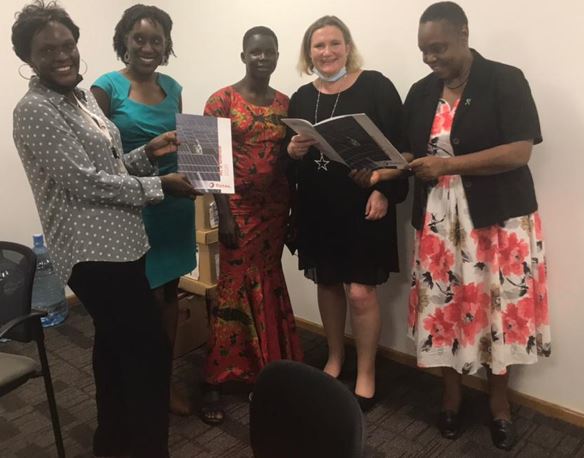
Caption: From Left to right: Sarah Kisoro (the representative of the oil and extractive action working group of WHRDN-U), Begg-Saffar (NGO and Human Rights Manager, Total Energies), Gladys Oyenyboth (Bulisa Community Grass root WHRD), Petronilla Lamunu (NGO officer, Total Energies) and Brenda Kugonza (Executive director WHRDN-U).


On 29/09/2021, Women Human Rights Defenders Network Uganda (WHRDNU) held an advocacy meeting with Total Energies’ NGO and Human Rights Department. The meeting took place at Total Energies Offices on Yusuf Lule Road, Kampala. The meeting discussed matters of protection of women human rights defenders who defend land rights of communities evicted due to oil extraction projects in Bulisa district.

We are grateful to Total Energies for using the UN principles on business and human rights and their commitment to work with Bulisa WHRDs to ensure that women’s rights are protected.