By the Women Human Rights Defenders Network Uganda (WHRDN-U) | Brenda Kugonza
As Uganda prepares for its Fourth Cycle Universal Periodic Review (UPR) before the United Nations Human Rights Council scheduled for January to February 2027, the Women Human Rights Defenders Network Uganda (WHRDN-U) undertook a nationwide consultative process to ensure that the lived experiences, priorities, and protection concerns of women human rights defenders are fully reflected in the country’s national reporting and advocacy agenda. The consultation comes at a critical moment, as stakeholder submissions for the 2027 UPR cycle are due in July 2026, making it urgent to ensure that grassroots voices meaningfully shape Uganda’s human rights accountability commitments.
Uganda’s previous UPR review in 2021 resulted in the acceptance of 138 recommendations and the noting of 132 recommendations. While this reflects continued engagement with the international human rights system, women human rights defenders emphasized that gaps remain in implementation and in the protection of those working at the frontline of human rights defense. It is against this background that WHRDN-U initiated a structured consultation process between March and June 2026, reaching more than 60 women human rights defenders across different regions of the country.
The purpose of the consultation was to document and elevate the voices of women human rights defenders in order to inform Uganda’s UPR reporting process and strengthen advocacy for improved protection mechanisms. The process specifically sought to generate evidence-based insights on the protection environment for women defenders, including progress made since the last UPR cycle, emerging risks, and practical recommendations for strengthening legal, institutional, and community-based protection systems.
The consultation brought together a diverse group of women human rights defenders, including those working on environmental and land rights, gender-based violence response, anti-FGM advocacy, Indigenous women defenders from the Batwa and Benet communities, women defenders with disabilities, structurally silenced women defenders, and those operating in rural and remote areas. This diversity ensured that the consultation captured intersecting realities of risk, exclusion, and resilience across different identities and movements.
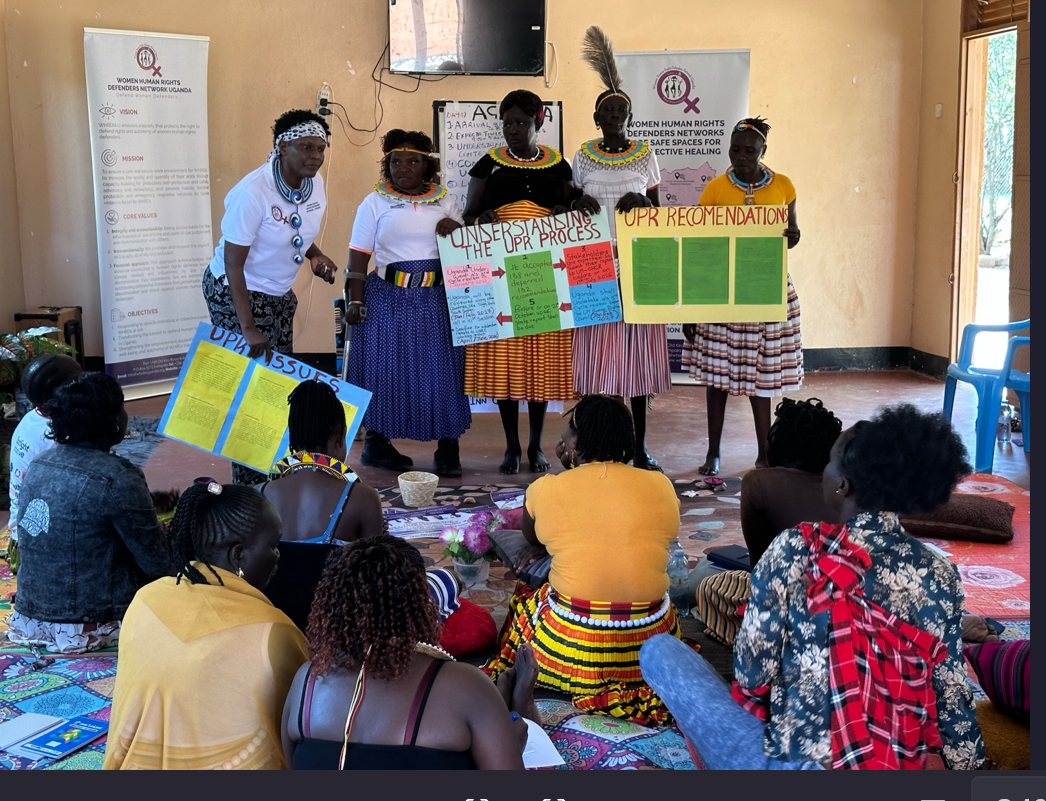
The consultations were conducted through participatory dialogue sessions designed to create safe and inclusive spaces for reflection and experience sharing. Women defenders collectively reviewed Uganda’s progress under the previous UPR cycle and discussed current protection challenges, barriers to civic space, and priority areas for reform. The process also enabled deeper analysis of how legal, political, social, economic, and digital environments are shaping the safety and work of women human rights defenders.
The findings revealed a persistent gap between Uganda’s legal and policy commitments and the lived realities of women human rights defenders. While Uganda has enacted important legal frameworks such as the Constitution of 1995, the Domestic Violence Act of 2010, the Prohibition of Female Genital Mutilation Act of 2010, and the Prevention and Prohibition of Torture Act of 2012, participants consistently reported that implementation remains weak and uneven, particularly in rural and high-risk contexts.
Women defenders working on female genital mutilation reported continued resistance rooted in cultural norms, which exposes both activists and survivors to threats, retaliation, and social exclusion. Despite the existence of the FGM law, enforcement challenges remain a serious concern, especially in border communities where cross-border practices persist.
Defenders working on gender-based violence highlighted ongoing risks including intimidation by perpetrators, interference in justice processes, stigma against survivors, and increasing forms of technology-facilitated violence. Online harassment, surveillance, and coordinated digital attacks were identified as growing threats that disproportionately target women activists and restrict their participation in public life.
Environmental and land rights defenders described experiences of criminalization, arbitrary arrest, detention, surveillance, and judicial harassment. Their work is often wrongly framed as anti-development, exposing them to public hostility and institutional pressure. Many also reported gender-specific risks such as sexual harassment, intimidation, and community stigmatization linked to their activism.


Indigenous women human rights defenders from the Batwa and Benet communities highlighted structural exclusion rooted in historical land dispossession, poverty, and geographic isolation. These intersecting inequalities continue to limit their access to protection services, justice systems, and meaningful participation in decision-making processes.


Women human rights defenders with disabilities reported systemic barriers including inaccessible institutions, exclusion from consultations, and lack of reasonable accommodation. They emphasized that disability rights issues remain underrepresented in national human rights discussions, further deepening their marginalization.
A particularly concerning finding was the situation of structurally silenced defenders, who face multiple and overlapping forms of violence including arbitrary arrest, surveillance, blackmail, eviction, and denial of essential services. Many reported self-censorships due to fear of reprisals, while organizations supporting marginalized communities face increasing operational and financial restrictions.


Defenders working in suspended civil society organizations reported severe socio-economic and psychological impacts, including loss of livelihoods, disruption of essential services, and increased vulnerability for communities that rely on their support systems. Electoral period-related risks were also highlighted, with defenders involved in civic education and election monitoring reporting harassment, arrests, intimidation, misinformation, and gendered attacks designed to discredit their work.

Despite these challenges, the consultation created a strong platform for solidarity and collective reflection among women human rights defenders. It strengthened shared understanding of cross-cutting risks, particularly those related to gender-based violence, digital safety, and shrinking civic space, while also generating a consolidated evidence base to inform Uganda’s UPR stakeholder submission.
The consultation further produced key recommendations aimed at strengthening protection for women human rights defenders. Participants called on the Government of Uganda to end arbitrary arrests, detention, intimidation, and judicial harassment linked to legitimate human rights work. They also urged the establishment of a dedicated, gender-responsive national protection mechanism for human rights defenders that addresses both physical and digital threats.
Strong emphasis was placed on the need to fully enforce existing laws, including those addressing domestic violence, FGM, and torture, while also strengthening national responses to technology-facilitated gender-based violence. Participants further called for the protection of freedoms of expression, association, and peaceful assembly, particularly during electoral periods, and for the removal of undue restrictions on civil society organizations.
The consultation also highlighted the need for targeted protection measures for Indigenous women defenders, women with disabilities, and other structurally marginalized groups to ensure their meaningful participation in national governance processes. Participants further called for improved access to justice, healthcare, housing, and essential services in safe and non-discriminatory environments.
In addition, women human rights defenders recommended the enactment of a gender-sensitive Human Rights Defenders Protection Law that explicitly recognizes women defenders and responds to their specific risks. They also urged Uganda to ratify the Optional Protocol to CEDAW to strengthen accountability mechanisms for women’s rights violations and to ensure meaningful inclusion of women human rights defenders in ongoing policy reforms, including the revision of the National Gender Policy.
In conclusion, the consultation confirms that women human rights defenders in Uganda continue to play a vital role in advancing justice, accountability, and community empowerment despite operating in increasingly restrictive environments. While Uganda has made important legal and policy commitments, significant gaps in enforcement and protection remain. The experiences and recommendations shared through this process provide critical evidence for strengthening Uganda’s 4th Cycle UPR engagement and advancing a safer, more enabling environment for women human rights defenders across the country.